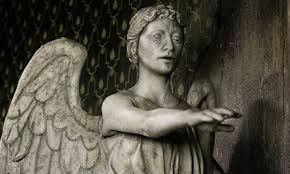
Twice, in as many days, the image of the joyous Christmas herald angels formed in my mind since early childhood has been challenged. First, when reading one of John O’Donohue’s poems this line jumped out of the page right at me “May the Angel of Justice disturb you to take the side of the poor and the wronged”. Then whilst listening to the wireless programme ‘A Yellow Light’, in which Nadin Ednan Laperouse recounts the traumatic death of his daughter Natasha from a severe allergic reaction after eating a sandwich. As his 14-year-old daughter lay dying in his arms he described vividly seeing several angel figures approaching and standing around her. Disturbed by their presence he tried to brush them away.
Both of these incidents reveal, that like many other of life mysteries, angels too are mysteries of paradox. As well as brining glad tidings their task would also appear to be to cause disturbance.
When disturbance manifest in our lives we tend not to like it. But what about being the one who causes disturbance, being the one who disturbs. What is it like to be that person? I’m no angel but I’ve been reminded on many occasions that I disturb people, some even pay for me to do just that. The hope of many is that a therapist will become their guardian, their salvation and their ‘bringer of good news’. Quite a shock then when I, as a therapist, view my task as absolutely not to do that. For what point would there be if such powerful ability was to reside in me? For the other, nothing would change.
It’s not unusual for someone at the start of a therapeutic process for them to ask what they should do? My response is always; be curious and be prepared to step out of any comfort zone. Some never return after this response, I guess it is they that recognise that I am offering an invitation, an expectation that they become disturbed.
Being a person who disturbs means being willing to be disturbed myself and to live my life often in the place of paradox. This often, uncomfortable place requires the willingness to recognise and then bring together the total and often extreme manifestations of the human condition within myself and within others. In practice, it means being able to hold in mind and value every version possible of the polar opposites that we all possess. It means naming them, calling them out, exposing them and placing them where they can be considered and where we can have a mind in relation to them. Love them even.
As a forensic psychotherapist and working in forensic settings this task is not as difficult as it may seem. There’s little illusion, or collusion actually, amongst those who have little reason to deny any more. I often encounter greater honesty and genuine connection on the inside of the prison gate than ever I do on ‘the out’. No, the challenge is found within other connection, relationships, friendships and of course within myself.
Being that person who causes disturbance is not formed or restricted to a job description or professional role, it is formed in the heart of life’s authentic experiences and cannot be turned on or off at choice.
Being that person who disturbs is also not limited to ‘what I do’, it’s also not about ‘what I am’ but more about who I am. This is in fact the essence of what some (and I) refer to as vocation. Vocation emerges as a way of being in the world in response to an internal ‘yes’ said to all of life and as it is represented. The occasion of me having that realisation and saying that ‘yes’ is another story and for another time. Enough to say perhaps that I’ve learned saying ‘yes’ is an ongoing requirement throughout life.
Vocation is, for want of a better explanation, all about saying ‘yes’ to paradox and accepting a way of being in the world without the need for denial, collusion or pretence. Owning this position, being willing to live it is what in psychology is referred to as living the authentic real self. If ever there was a purpose to any therapeutic process, it is this. If ever there was a time when this was required, it is most surely now.
Being that person who disturbs is, I have come to appreciate, one of the consequences of vocation, of saying ‘yes’ to life. Being the person who disturbs means saying “yes’ to the wholeness of life – light and dark. For one without the other, is no life at all. Being that person who disturbs means saying ‘yes’ to life not just once but over and again and again and again.
Saying ‘yes’ to life is the vocation we are all called to. Just how that gets played out for each of us will, for certain, hold many challenges. Whatever your place of authenticity is and whatever my place, we will each often find ourselves being an angel to others and always in need for one or more of those cherubs ourselves.
Br Stephen Morris fcc