Christmas does not offer us respite from reality. This truth was writ large in the middle of a chapter I was reading recently. It resonated. It’s hard truth stayed with me and eventually brought relief of the kind that so often only hard truth can do. On reflection, it is a truth that I have long known and am reminded of on an annual basis.
My clinical role in recent years is sharply defined.I’m not required to work over the Christmas period. But throughout previous decades many Christmases were spent in responding to the forensic psychiatric demands in prisons, secure settings, A&E, police stations or in the back of ambulances. Each one a backdrop for unfolding events which proved many times over, for all involved, that Christmas does not, has never and will not equate with all that the tinsel, baubles, fairy lights and festive fare have conditioned us to believe.
No matter how much we may have invested in its trimmings, the reality is that Christmas always has and always will sit in the middle of the mess of life.
I shared in one event that stands out in my mind and has become, because of memory, an annual reminder of the hard truth of Christmas.
In one of the large London prisons on a Christmas day afternoon, I received an emergency call in the middle of association to go the fours (4th landing). The scene that greeted me was a tangled mess of officers and prisoners doing all they could to release a prisoner from the ligature he had tied around his neck before throwing himself under the iron stairwell. His positioning was precarious.
Four of the prisoners were trying to hold him up whilst the officers were trying to release him. Suddenly he was freed and brought onto the landing and laid on the ground. All involved surrounded him, not knowing what to expect, it was completely silent and that moment in time is fixed into my memory much the same as a nativity scene. But this occasion was not defined by new life, but by a new death. It was all too late. The prisoner was dead.
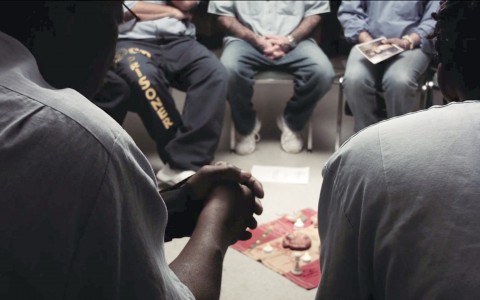
Over the weeks that followed, I met with the four prisoners involved. We met together in an empty cell for an hour each week to talk about what had happened and importantly what it had left them with. It had taken all their strength over a considerable amount of time and at risk to themselves to hold up the man.
Those moments of trying to hold onto life , which they all said felt like hours, they hoped that he would be ok and that they would have saved him. In the days that followed the reality of the loss of their hope did many things to them and that is what we talked about together.
In the very last session and just moments before the end, in the poignant silence that often characterises the last minutes of a special experience, one of the prisoners asked a question and in so doing made a statement “But what about all the Christmases to come? We’re going to remember this every Christmas. Christmas is fucked”.
Now in 2025 there are many of us in less dramatic circumstances who nonetheless, because of what life does to us, are able to identify with that prisoners’ statement of truth. Buying into any tinsel fairyland world does not serve us well. Failing to acknowledge that life is messy is,in its essence, the denial of our vulnerability and such denial always, always, always carries a high cost.
In the midst of the pains of life, to engage in thinking that life will just be the same will set us up for not only massive disappointment, but also for massive trauma. Being in conflict with reality is quite literally a madness, a form of psychosis.
There are voices of wisdom in our world trying to be heard amidst all the denial and delusion. The voice I heard that addressed this very issue by naming a hard truth was that of Pope Francis when he asked us to recognise that we can’t expect to live in a sick world without becoming sick ourselves.
I still hold those four prisoners in great esteem, they taught me much. Yes esteem, for the heroic efforts they made on that messy Christmas day, but more so for what they were willing to do in the life that continued. In our little cell they named their fears, angers, hurts and vulnerabilities. In so doing, they accepted the messiness of that Christmas day, of life as it was in the moment and the life that was to come. In the hard truth of all of that they gained a wisdom, a knowingness that I am confident is still serving them well. In the mess of Christmas, we have the same opportunity.
Br. Stephen Morris FCC
