• Delusions of Safety

    Outrage can achieve many things one of which it would seem is to prevent intelligent thinking. Look no further than the front page of the daily papers. They are often full of outrage in relation to the latest murder or threat to life.

    Along with such headlines, comes calls for a whole variety of measures to be taken. These measures can range from replacing key figures within criminal justice, building bigger prisons and if this Government is in power for much longer Braverman and her like will be calling for the return of the death penalty. Fact is, such suggestions are nonsensical for the very fact that they are informed by delusion and a distorted belief that the world is a safe place .

    The buy in, to the delusional belief that the world is a safe place and, on the occasions when it is not, that we can make it safe is delusional in the extreme. Such, has never been possible and never will be possible. Of course, as with many delusions its seductive, it sounds nice and many buy into big time.

    ‘See it, Say it, Sort it’ has been brainwashed into our thinking every time we board any form of public transport. In the face of occasions when we are reminded that mass murder can and does happen, ‘See it, Say it, Sort it’ quickly becomes delusion in action. Its purpose, to have us all seduced quickly back into the sense that we were still in control and safe. It does not require much intelligence to recognise that in the face of seemingly random bombing, backed up by a belief system and carried out by those sacrificing their own lives, safety is not possible and we are most certainly not in control. The delusion would, at best, last until the next bomb goes off, as indeed they do and will. The mantra is now so frequent that I doubt if anyone really hears it anymore and given that intelligence gets suspended so readily, they may also have well forgotten what it’s all about.

    The expressions of outrage no matter who they are about are so without insight that if applied, then no one, absolutely no one is to be ever trusted again. How mad is that!

    There is no analysis in the news headlines of today, just emotive re-action. No invitation to consider how or why people come to be a threat, arrive at being dangerous, and present to the world as high risk. Also fact is, murderousness and other dangerous actions fit totally within the range of the human condition, that also includes you and I.

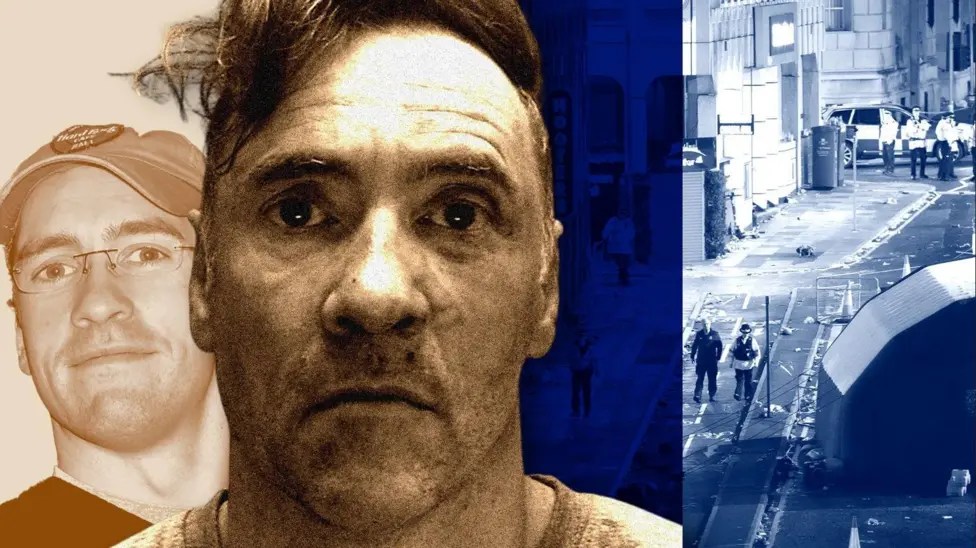
    To refer to recent examples, Lucy Letby and Benjamin Field are not unique or alone. Allitt, Dr Chapman and others all went before and others will be, as I write, engaged in similar behaviour, just not yet known about. Within noble professions the esteemed or in positions deemed less professional odd jobbers like Fred West , will be at it right now…. prepare to once more be outraged.

    It is not just the fact that the world is a dangerous place that we are constantly invited to deny. We are also invited to deny the full reality of those who murder. This is especially so when those who murder come into conflict with idealisations and saintly archetypes held within us.

    Just because someone is an enforcer of the law, a nurse, a priest, a doctor, a mother, does not mean there are without the capacity and motivation to murder. Some do and some will. Experience tells me also that it is many who are never discovered, that being because our upheld belief which goes something like ‘they could just not’. In terms of permission giving, that is a gift.

    A delusion of ‘safety’ rather than connection with reality is not the only investment such denial invites us to make. We are also told to think that those who murder are ‘monsters’. To sight another case, how quickly was the identity of ‘police officer’ removed from Wayne Cousens and replaced by ‘Monster’. You could almost feel the collective relief, with the application of just one word, he was no longer one of us, he was no longer like me. Another lie. Another delusion.

    The truth remains that Wayne may have done something monstrous and criminal, but that does not make him a monster. He remains, as you and I, deeply human and with all that implies. I don’t know if I will meet him in the coming years, but I know for certain that, if so, he will sit opposite me in his entirety, the full picture and I will listen to that full story, albeit too late.

    The human condition is raw and primitive. Combinations of factors, conscious and unconscious come together in the immediacy of murder and other behaviours. All of us are vulnerable to this. These are the dynamics and features that do not get talked about and for which the media headlines like those of today and no doubt tomorrow do not allow. But the dynamics of murder can be much closer to home that many would like to acknowledge.

    Failure to be able to embrace this truth is the greatest danger we face. Such failure gives rise to the delusional thinking writ large in the headlines today. Delusion stops our capacity to see, hear and to discern. We buy into it at our peril and the stories when they need to be told then remain untold, unheard and in time honoured fashion are then tragically acted out.

    Br. Stephen Morris FCC

  • Talking Difference is Exhausting

    Talking difference can be exhausting, it can wear you down and wear you out! Here I share some reflections that can help us to keep talking …….

    ‘Talking Difference’, these two words convey so much. At a deeply personal level I know I have spent much of my life doing just that – talking difference. Many others reading this will have had the same experience and in a myriad of different ways. Our lives are not all the same. It is our many uniqueness’s that make the world we inhabit rich beyond measure in its diversity and creativity. There is much to recognise and celebrate when we talk difference.

    Talking difference is also for many a very specific experience. There are contexts of life that can make difference a day to day struggle. When a particular context values one way of being, identity or culture as preferable over another then such valuing can often and does render anything different as devalued, rejected, unacceptable, less than. When life is lived outside of the accepted and valued then, as well as being characterised by difference, such an experience of life is characterised by struggle. The struggle is often manifest in the struggle to have a voice. A voice that is often required to address assumption, denial and sometimes hatred.

    I came out as gay when I was in my early teens. I’ve been coming out ever since. Having initially thought of it as a ‘one off’ thing to do, life soon taught me that the process is never ending. Like many, that difference is not the only difference that makes Br.Stephen Morris who he is. I sometimes also need to come out as being Irish, people are usually more shocked about that! These two aspects of my identity have required me to have a voice and often to struggle to have that voice heard. When talking difference is a daily experience because of who you are in the world it can be tiring, literally exhausting. It requires resilience.

    If two ‘coming out’s’ were not enough. I have a third. I often need to come out as a Franciscan Brother, especially when my work does not permit me to wear my habit. Coming out as a consecrated Brother requires me to have faith and it requires me not to lose heart. We are all in some way engaged with the world and its many discouragements. So we are all required to have faith in something and not to lose heart. I’m not alone.

    If you are concerned about the environment, equity, the welfare of refugees, social justice and those we work with, it is very easy to lose heart. Recognising the very real risk of losing heart poses the question; how do we not let ourselves spiral downwards into hopelessness? or, if we’re finding ourselves going downhill, how do we pull ourselves up?

    Well, having faith helps but, faith alone will not change anything. Not losing heart requires action and thankfully that is something we can all do. The reason we may start to lose heart is that we allow ourselves to get hooked by our emotions. No matter who the target of our emotion is, it’s usually someone or some situation that hooks us. Once we get worked up we start to lose our effectiveness. We lose our skill to communicate and in so doing we lose our ability to do the one thing that is most often within our reach – to uplift ourselves and those we encounter. We can observe this process times over in the interview room, on the prison landing and of course in the many different areas of our own lives.

    When we fall onto the hook of our emotions; anger, resentment, whatever, we disconnect, we start to go a little unconscious. So, the first step of not losing heart is to become aware of when this happens. Once we are hooked we lose our sense of everyone having the same vulnerability, of the shares human desire to know happiness and avoid pain. In this cut off state we can fail to recognise the basic goodness in people and within ourselves. Becoming more aware of when our emotions get in the way of connection, keeps us conscious and from that place we are more able to see and experience the wider picture which is seldom a complete reflection of our emotions.

    When we are losing heart because of our own struggles in life, one of the best antidotes is to put things in a bigger context. I always find it a profound moment when, after listening to a service users account of their offence and often horrendously destructive behaviour, they stop and looking directly at me say “but I am good person”. I always experience that as a plea. A very human request of ‘now you have seen the worst me, please also see the best of me’. Seeing the wider picture, no matter what they have made me feel, is crucial if I, if we, if they, are not to lose heart.

    Widening our perspective and becoming more conscious individually also has a positive effect on wider society. It can have a massive impact on our ability to embrace and value difference.

    When we are continually faced with aggression, violence, greed, injustice, insensitivity to another’s pain the invitation is always to close down, to polarise and in that process lose heart. These experiences, can if allowed, take the ground from under us and if we’re not careful we too can find ourselves not caring, not connecting, losing faith in others and in ourselves. It is in these moments of vulnerability that the task is to remember how everything we do matters and that includes talking difference.

    Talking difference from the vulnerable place of being fully conscious can help us stand tall and resilient without resorting to defensiveness, striking out, closing down or polarising. One less person doing that in the world is going to make a difference.

    One more person taking a wider perspective and being willing to see beyond all that which would make us want to turn away, will make a difference. One more person having faith in our own and others basic goodness wont suddenly remove all that which would make us lose hope and neither will it suddenly make us certain.

    Constant certainty in the work we do, with others and on ourselves is seldom, if ever, possible. But the opposite of faith is not doubt, it is certainty. So, it’s absolutely ok not to feel certain when we talk difference. A lack of certainty does not stop you or me from, in faith, making important contributions to the world. If that means talking difference then there is every reason for us to start to practice not losing heart and …. to keep talking.

    Br. Stephen Morris FCC

  • Going to the Places that Scare Us

    It’s not unusual for me to receive enquiries from people interested in working in the field of crime and criminal justice. They often ask with great excitement ‘what do you do?’ ‘what does your work involve?’ Their excitement often visibly diminishes when I explain:

    “It involves approaching what I find repulsive, helping the ones I think I cannot help, and going to places that scare me”.

    My explanation is spot on, truthful and does indeed reflect the reality, but they are not my words. They are me owning the wise words of Pema Chodran in exhorting us all, when faced with the chaos and darkness of life, to live more fully, more humanly and more courageously by; “Approaching what we find repulsive, helping the ones we think we cannot help, and going to the places that scare us”.

    Her words also explain my absolute admiration for all those I have worked with over the years who, despite having done terrible things and scared others in the process, are willing to go to the places that scare them. They, of all of us and Pema, know that those places are always, always, always, within ourselves.

    You don’t need to work in prison, probation, police or secure hospital and you don’t need to have committed any crime to also respond to Pema’s encouragement to, when faced with the chaos and darkness of life:

    “Approach what you find repulsive, help the ones you think you cannot help, and go to places that scare you”…. Then the task is, to see what happens.

    Br Stephen Morris fcc

  • Sexy Serial Killers

    ‘The Fall’ is one of those TV dramas that many revisit and of course it’s invitation to have murder in mind. …..

    James Dornan, the immensely talented Irish actor, will forever sit in the mind of many as a serial killer. A lasting impact I guess, of the unrelenting intensity he conveyed in his portrayal of Paul Spector via the awesome production of ‘The Fall’.

    Just as the books about ‘Fred and Rose’ flew off the shelves in their millions, so too does the darkness of ‘The Fall’ appeal to a society which still struggles to really comprehend the capacity of the human condition for the vilest of offences. The only way it seems that we can get our heads around the fact that the human condition can be murderous is to convert it into entertainment.

    As long as we place the dark capacity of the human condition into a book, painting, play, poem, dance or TV series, especially one as good as ‘The Fall’, then we can keep all our primitive darkness, murderousness, perverse desires, violence’s, rages and destructiveness separate, away from us, unintegrated and, just as dangerous as the serial killer does, ‘split off’.

    Evidence of our need to ‘split off’ our capacity for primitive violence is also expressed by many who conveyed their surprise at how handsome, sexy and good looking was Paul Spector. Such comments, and they were many, reminded me of the very first group therapy I facilitated for men who, like Paul Spector, had raped and murdered.

    In the weeks leading up to starting the group myself and my co-clinician met with about fourteen referred men to carry out individual assessments to see if they were ready and suitable for intervention. We needed a group of no more than eight. Over several weeks we divided up the men and conducted the assessments on a one to one basis. My co-clinician and I shared an office. I remember well him returning after conducting one assessment looking red in the face, slightly energised and unsettled but grinning all over his face. He noticed my immediate curiosity, sat down and said to me “Oh my God! that one was absolutely gorgeous”, We laughed long and loud.

    Murderers, rapists and especially serial rapists are not meant to be ‘gorgeous’ and certainly not sexy. The fact of course is, that there is absolutely no reason why they should not be and, having met many, I can evidence that many are indeed ‘gorgeous’. The issue for the forensic setting, for the wider community and my co-therapist, is not that they cannot be ‘gorgeous’ but that we should not be seduced by it. Gorgeousness and dangerousness are not as incompatible as we like to think.

    I loved the fact that Paul Spector was not only sexy, he was also a bereavement counsellor. What a great role for us and for him to fulfil the task of ‘splitting off’. Both, accurately fly in the face of the monster we need him and other men and women like him to be.

    My business is public protection, working with the human condition to make our world a safer place. The biggest challenge to achieving this is not the Paul Spector’s I meet; the real dangerousness and risk is in the minds of those who need monsters to look and sound like monsters. It is in the mindset that can entertain Fred and Rose when they dwell in the chapters of a book but not if they are living next door.

    Fred and Rose did not do what they did once we knew about them, it all happened when they were just neighbours. Paul Spector did what he did at the same time when he was busy being a; bereavement counsellor, a loving father, a boring husband and of course, being gorgeous.

    If we can bear to think what ‘The Fall’ invites us to, it could well be the biggest public protection crime prevention campaign we have ever known. We, and the unintegrated monster in us, needs it.

    Br Stephen Morris FCC

  • When Silence is a Sin

    The independent inquiry into child sexual abuse highlighted many times the horrific incidents of abuse within religious institutions.

    The Inquiry also made clear how a considerable number of faith leaders collude, cover-up and deny the experience of victims. In particular, the report mentions a series of religious groups including Jehovah’s Witnesses, Baptists, Methodists, Islam, Judaism, Sikhism, Hinduism, Buddhism, and non-conformist Christian denominations. Other reports have covered both Anglican and Catholic institutions. All are implicated in their moral failure.

    This report however brings something new to our attention; the fact that some seemingly integrated faiths, operate using abuses of control and power more readily associated with extreme sects.

    I have long been aware that within State accepted religious organisations, individual leaders can create and use the dynamics of a sect for their own ends. The indicators can be frighteningly obvious, but in religious cultures that often thrive within the guise of ‘chronic niceness’, they seldom get recognised for what they are. Even when suspicions are raised or evidenced all too often the wall of silence and the collusion with chronic niceness results in victims being ignored and their abusers remaining in power.

    In the context of religious organisational abuse, not all abuse is sexual; domestic, physical, psychological, emotional, financial and spiritual abuses all feature. Sects exist within mainstream religion of all faiths with the knowledge and often the blessing of their hierarchy.

    The report from the Inquiry usefully made clear indicators of high control sect like dynamics that, if present , should be recognised as a serious cause for concern, including:

    Victim blaming

    Not openly discussing matters of sexuality

    Abuse of power by religious leaders

    Men dominating leadership

    Lack of accountability

    Mistrust of non-religious agencies

    Misusing the concept of “forgiveness”

    Dealing with reported concerns in isolation

    Poor understanding and non- application of safeguarding procedures

    Exclusivity, favouritism of individuals or cliques

    The Inquiry also found that in some faith communities “the relationship between ideas of sexual ‘purity’ and social and familial standing are likely to make abuse markedly harder to report.

    The imperative not to speak is bound up with notions of honour, with consequences for an individual’s ability to marry, for their family and for the ‘honour’ of their community. In extreme cases, being seen as dishonourable can lead to violence against that individual or their family.

    It is this cycle of abuse I see played out on a regular basis with young gay men forced to deny their sexuality in order to please mum and dad. It never ends well. Secret lives are led, conflicted sexuality manifests in violence and murders take place. These factors are reflected daily in my work with those who also become involved in chemsex related crime. These men have often created many victims but they too are indeed victims.

    In all of this, silence is the most defining, dangerous and permission giving factor. Silence, I’ve concluded in this context is indeed a sin and is in need of an Inquiry report all of its own. In my career spanning over forty years, the one consistent message I have been required to give is the need for those who know of abuse, to speak out and to speak out even if uncertain. Inquiry reports speak out, but will remain limited in effect if others closer to home remain silent.

    Those who abuse, who collude and cover up are of course never silent …. leaving victims to persist alone.

    Br. Stephen Morris FCC

  • Madness is Often Very Intelligent

    I’ve experienced enough madness in my life and work to confidently recognise that its main causal factor is when a significant experience that we know to be real and true is denied by those around us.

    When our reality is not witnessed or affirmed it can take us into the realms of insanity. If you said to me each day that the sky was not blue it was brown and if those around remained silent and did nothing to affirm my reality of seeing it was blue, I would eventually become very mad indeed. This process is often experienced by those who have been abused in one way or another. No one witnesses it, those around do not believe it, the perpetrator denies it, then the impact of that over time is madness.

    Activists and those who work for truth and justice can also be vulnerable to such damaging levels of denial. If you are saying something that others do not want to hear, if those around you cannot tolerate anything other than their own agenda, if the truth of your message is uncomfortable then, again and again, you will be confronted with the negation of your experience, belief, identity and value.

    Whatever our cause, what we all require to keep us sane is a reliable witness, someone who is able to say’ you are right, I hear you and I get it. An effective witness enables us to recognise that when we have been made to feel insane, it is often because we have named something, revealed something that others with to think is unthinkable. These moments, rather than being silenced by self doubt or allowing ourselves to be convinced of insanity, are in fact moments when we can be reminded that madness is in fact very intelligent.

    Being witnessed and being a witness for others is a powerful reminder that we are not in this world alone. To experience both is a privilege indeed and often the very light that we all need.

    Br Stephen Morris CJ

  • She said Nothing .. so I Killed Her ….

    She Said Nothing, So I Killed Her ….

    ….then nothing was said ..

    A murderer once said to me … “She said nothing … so I killed her, so nothing was said”. This statement made me think about the power of silence and how we experience it. Here are my thoughts:

    “The dumb silence of apathy, the sober silence of solemnity, the fertile silence of awareness, the active silence of perception, the baffled silence of confusion, the uneasy silence of impasse, the muzzled silence of outrage, the expectant silence of waiting, the reproachful silence of censure, the tacit silence of approval, the vituperative silence of accusation, the eloquent silence of awe, the unnerving silence of menace, the peaceful silence of communion and the irrevocable silence of death Illustrate by their unspoken response to speech that experiences exist for which we lack the word”. – Leslie Kane (1984)

    For me, the sacredness of silence, I have come to recognise, has more often than not been experienced away from and outside of the environments commonly associated with prayer, contemplation, adoration and reflection. Yes, I love the early first hours of each new day, the closing hours of darkness and daily visits to the Blessed Sacrament, but these occasions are relatively short to what unfolds hour by hour in my daily work.

    For the majority of each day I am in constant dialogue and relationship with others. The context of a Police station, a court room, probation office and a prison wing, is one of immense business, the noises of distress, internal and external conflicts, negotiations, relief and … the list goes on. I guess the same can be said about many different working environments including yours.

    But of course, sacredness and its many manifestations of silence is to be found in all of these places, experiences and contexts and is not limited to the cloister, church or chapel.

    My awareness that silence and its sacred contents did not come from known holy saints, priests or spiritual directors. My eyes and heart were opened to silence by the very first prisoners and offenders I met and by others who worked with them.

    In the early days of my forensic training, I was privileged to be taught by Consultant Psychotherapist, Dr Murray Cox. Murray was also a Shakespearian scholar and integrated his immense knowledge fully into his clinical thinking at Broadmoor. He inspired me as no other, to understand silence as one of the most meaningful communications and introduced me to the work of Kane as quoted above.

    Murray died many years ago now. I continue to be reminded of him daily as I now consult to younger clinicians, police and probation officers helping them to develop ways of being with people who often no other wants to be with. When seeking to support them in this challenging task, it is not unusual for them to express relief and delight because their client is talking about his or her offence with great ease “He’s doing very well Stephen, he talks about his offence all the time”. My response is seldom one of joy. In this situation I am only too mindful of one client who declared; “She said nothing….. So, I killed her, then nothing was said”.

    This powerful statement on silence enabled me to recognise that when a client, tells their story easily, this usually signifies that it is not the part of the story that needs to be told. Casual telling, always indicates that there is story, a much earlier story, that the client may not be able to bear to tell at all. It is this story that needs to be told and it is this story, if no more people are to be killed, that needs to be heard.

    We all have stories that need to be told and we all need silence in which to tell them. Silence alone can take us beyond our initial telling. Beyond the story what we first tell ourselves, others and God. It is this story that needs silence to emerge in its fullness, no matter what it sounds like and no matter what it holds. Even our untold stories can have a murderous effect.

    The importance of allowing and staying with silence is not only crucial for my forensic clients but is also crucial for us all. We can all move through the day being more aware of the many communications within silence. Not only we will start to hear the important untold in our own stories, but a myriad of other communications will also open up to us in the lives of others. The sacredness of this process can of course happen in all the places we have been conditioned to consider ‘holy’ and in many other places, equally ‘holy’, but outside of our conditioning. Perhaps, even more often than we allow ourselves to notice, the sacredness of silence happens and is happening in the groundedness of our untold stories, in the fullness of life and in all its glorious noisy mess and messy places …

    But first I guess we have to learn to shut the fuck up!

    Br. Stephen Morris FCC

  • Shame and Shaming Does Not Justice Make

    Throw away the key’ is a term applied by some, to most if not all, of the men and women I have worked with in prison, probation and policing. It’s a term informed by hatred of a person rather than an informed understanding of how that person behaved at a particular moment in time. The term holds an implied wish to impart suffering rather than a restorative, redemptive justice.

    It’s an appalling indictment on the UK Government that, on an almost daily basis I am reminded how such a revengeful wish can also inform the thinking of politicians and government ministers.

    It never takes very long for statements made by desperate prime ministers to make claims about how they will reap revenge on those who do wrong. In a barely disguised wish to shame and humiliate, it’s not that long ago the UK government announced a plan to make people sentenced to community service wear hi viz jackets identifying them as such. Such thinking can only be recognised as abusive and deeply inhumane.

    Such public labelling repeats the very experiences of what often informs the early lives of many who offend. What we in criminal justice attempt to achieve is to address the unhealed trauma of the past by facilitating the growth of self-esteem, self-worth, self-respect and, crucially important, the instillation of hope. It is these aspects of the human condition that prevent re-offending. Since when did public humiliation ever serve to redeem and make whole again? Never. It cannot.

    Acts of revenge, naming and shaming are dangerous., They are also especially damaging when done to the powerless by those in power. Shaming and humiliation are never useful experiences, they are weapons of abuse. Having commissioned an offence people, starting out on a journey of reparation, require every encouragement to change and to be different. The most powerful motivating factor is for them to grow and discover hope.

    Labelling someone as bad at that point, at any point, removes the essential essence required to change, live and remain living. That essential essence being hope.

    No one therefore has such a right to ‘throw away any key’ in whatever way they choose to do it or imply it. As a forensic clinician, I learned early on, no matter what psychological torment or anguish I was being asked to address, my main task was the instillation of hope. For without hope little else is possible. Without hope, what are we?

    During my year of specialising in the treatment of trauma at the Tavistock Clinic. I was privileged to be tutored by Caroline Garland. It was Caroline who introduced me to the term ‘the instillation of hope’ She described hope as like a mineral, it grows and diminishes according to its environment and treatment. In the lives of the many I have worked with I have now seen this process repeated many times.

    There are two environments that have taught me most about the instillation of hope. I know both environments well; the prison and the monastery. Without a doubt they are both most certainly places where the human experiences of hope and expectation manifest in their fullest. On arrival in both settings much has usually occurred in the external world to have diminished hope to the point where there is often little if any left. In the solitude and separation provided by both settings, and contrary to often naïve public understanding, both prison and monastery provide the ideal conditions for hope to grow and be lived again.

    Both Prison and monastery, if allowed and resourced, to fulfil their task will make clear the potential of a future, a vision and a way forward.

    Hope is not to be found in complex interventions, formation programmes or expensive schemes. It is found and manifest in human connection, in human valuing one to another where the harms of the past are not repeated. Human connection can be as simple as a smile. On a prison landing a smile and a authentic greeting can be immensely powerful. Many prisoners over the years have taken time to thank me just simply for that.

    Across the world, in prisons and monasteries, there are awesome examples of manifest hope and transformation arising from environments where a sense of connection and being in the mess of life together has been allowed and nurtured.

    In a humane society we can all share in the responsibility of holding hope for others and indeed playing an active part in hopes installation. The main resource we can offer is ourselves. We know that it is the relationship we establish with those who have offended that can provide often longed for experiences of safe connection. Our relationships can offer the experience of a secure attachment. Such relationships founded in hope affords respect and dignity. When founded in authenticity, hope is installed and lives are changed.

    To identify someone who has offended by dressing them up in a labelled hi viz jacket comes from a sadistic mindset. It is vile and beyond the sacredness of humanity. In the redemption of the world, we are all called to be so much more than that.

    Br Stephen Morris FCC