Suicide, this powerful act of leaving our world, is no stranger to me. It has been the means by which people have left my life in the context of my work and on occasions in the ‘non work’ places of my life. Just this week, a young man I worked with a few years ago appeared on my screen as part of an intelligence search I and colleagues were conducting. The report contained the observations of how the ambulance personnel had found him on being called to his address. To use John Donohue’s words, I once again was faced with “the sudden wall of dark” and since have found myself remembering. So for Nick and all those that know about suicide here are John’s words of blessing in full ….
‘Cunts Corner’ was the name, given by the women in HMP Holloway, to an area of the visiting hall where women would sit if their visitor did not turn up. The term communicates powerfully how it must have felt sitting there. The expectation and significance of a visitor when serving a prison sentence is immense. When that visitor does not turn up and your surrounded by another 100 women whose visitors have tuned up imagine for a few moments how that would feel ……. ‘Cunts Corner’.
But such feelings of difference, being made ‘other’, outcaste, unwanted, alone, being made ‘less than’, rejected, devalued and judged are not confined to the women who once sat alone in HMP Holloway. Political, Governmental, social, religious, family, professions, work places, educational establishments, schools, indeed all institutions can hold well established ‘Cunts Corners’. They can be recognised, discerned, detected by the kind of statements they make, policies they endorse and laws they ignore. Just a few weeks ago and not for the first time, it was the Anglican church that thought it totally acceptable to make statements affirming the oppression and the devaluing of large sections of society. ‘Cunts Corners’ clearly exist in all areas of life.
‘Cunts Corners’ also exist within the LGBT community and especially within the commercial gay scene. If you look ‘right’, sound ‘right’, wear the ‘right’ clothes’, have the ‘right’ body shape, are the ‘right’ colour, are the ‘right’ age, are the ‘right’ HIV status, go to the ‘right’ places and have the ‘right’ size cock then don’t worry you will never see ‘Cunts Corner’. Fail on any one of these and your heading right there!
‘Cunts Corners’ exist every time a ‘less than’ culture is allowed or ‘less than’ statement is made. Such statements can be made and heard far from home and very close to home. Nobel bishops and dukes may make them, but sometimes it is our friends that make them, our partners and those we loved and respected. It does not matter who makes them for the consequences are the same.
Let me be clear, as I think many fail to realise the full impact of such statements. Every time such statements are made new waves of hatred flood towards people of difference. New waves of bigotry are given permission and new waves of hate crime encouraged. Whoever it is that thinks it possible to make ‘less than’ statements, such arrogant and self-righteous statements banish beautiful, loving, creative souls to the hell of a ‘Cunts Corner’. This in 2025 is happening and it is the shameful reality.
Let me continue to be clear. If you have remained silent in the face of such statements and manifest hatred, then you too have played your part in the creation of such places and the denigration of another.
I was five years working in HMP Holloway. Throughout that time, I witnessed immense compassion for those women who were made to feel ‘less than’. I often witnessed a caring and sharing that I seldom see in many other settings and rarely see in the gay scene. As long any individual is made to be ‘less than’, as long as any individual is relegated to a ‘Cunts Corner’ then it is a reminder there is much to do and much not to be silent about. The next time you witness a ‘Cunts Corner’ in operation, call it out! speak it out! Enough is enough!
Speaking out needs only to be a small effort. But small efforts, as Dorothy Day reminds us can have a massive impact “People say, what is the sense of our small effort? They cannot see that we must lay one brick at a time, take one step at a time. A pebble cast into a pond causes ripples that spread in all directions. Each one of our thoughts, words and deeds is like that. No one has a right to sit down and feel hopeless. There is too much work to do”.
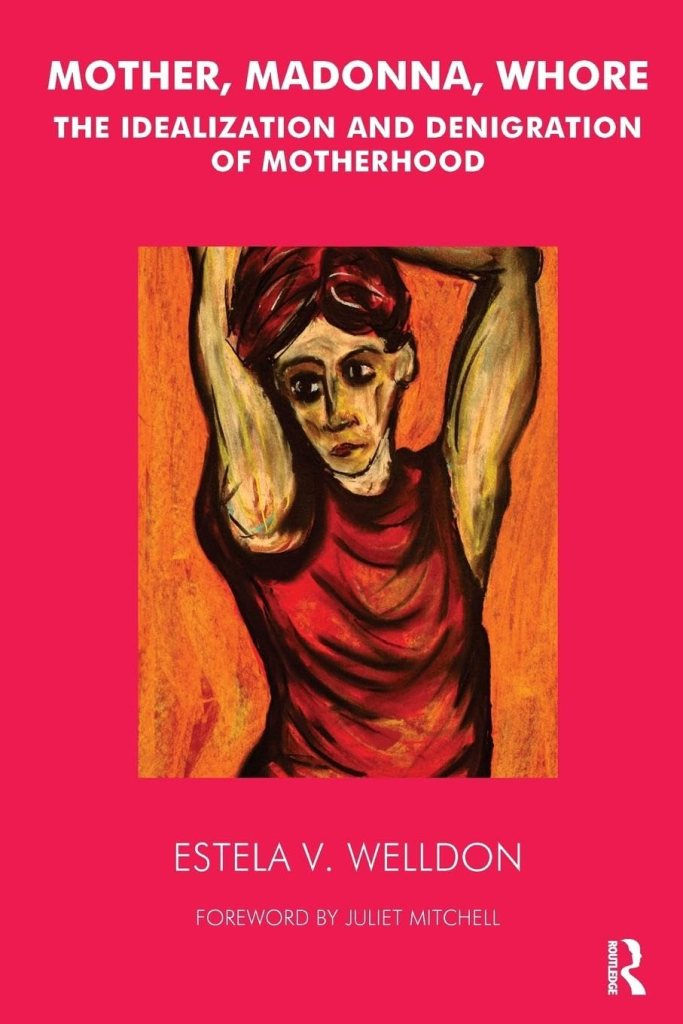
Mother’s Day’ for many, is not a happy time and is for more than we would like to think, a deeply traumatising time. Perversely, I would love to turn the front of Estella’s book ( see image below) into a Mother’s Day Card. It would not sell. Such a card would challenge the massive investment which goes into maintaining the saintly Madonna archetype of ‘mother’. Try challenging this and you soon discover just how heavily defended the associated beliefs are. For those who have endured and traumatised by a monstrous mother, society seldom offers a reference point.
There are those on ‘Mother’s Day’ that cannot take resource in denial. There are those each ‘Mother’s Day’ who know from witnessed or actual experience that mothers do sexually and physically abuse, that mothers do torture and murder their children and that mothers can inflict over many years sadistic emotional and psychological abuse. The number of mothers convicted of such crimes is not as insignificant as is often argued, but since when did minimal numbers lessen the lived experience of even just one victim.
Denial for the victims of a mother’s crimes is always a double trauma with its own particular symptoms and destructive impact on life. For mothers who have committed crimes against their children, then the denial that surrounds their existence is nearly always a triple trauma; the unhealed trauma that has informed their own harming behaviour, the trauma of what they have done and the trauma of themselves not having a reference point. During the years I worked in HMP Holloway, I met many mothers caught in this immensely painful trinity.
Remaining wedded to the saintly image of motherhood, even on ‘Mother’s Day’ serves no one well.
Following a violent criminal attack at Westminster, the media were so lost in their sensationalist reporting, they failed to invite any useful analysis or reflection. Rather than relying on the BBC to stimulate my thinking, I turned to my own experience of crime and my training in forensic psychotherapy. Whatever type of offence I am confronted with my starting point is always the same, ‘What is the meaning of this?’
The real meaning of a crime, all crime, can be identified by the one aspect of it that characterises its manifestation and its consequences. Knowing the real meaning of a crime is absolutely crucial is being able to respond effectively to manage the associated risks and particularly in our response to prevent further crime.
The real meaning of a crime is often not the one we would prefer to acknowledge. Often the real meaning is one that connects us with discomfort or truths that are hard to acknowledge. This applies to both the perpetrator and to victims. To discover the real meaning and purpose of a crime we need to ask what is it that the crime in question is communicating? More importantly, what is its unconscious communication? If we can answer this question, then we have an opportunity to address causal factors and reduce further risk to victims. In some instances, further repetition of the crime can be stopped completely.
The crime of terrorism is a good example. The unconscious meaning of terrorism is not so readily available for assessment. But if we look at the various components of a terrorist act, it does not take long before it is possible to identify the one characteristic of it that gets repeated again and again by all involved. That defining characteristic is the experience of vulnerability. Terrorism, for its perpetrators, supporters and victims is all about vulnerability and not in fact about terror.
The motivating factor for a terrorist act is vulnerability. The motivated terrorist has perceived that something they hold dear or indeed that they themselves are under threat, under attack, that they are vulnerable. It is the perception or the actual realisation of this that informs the defensive response of a, bombing, shooting, stabbing, kidnap or other atrocity. The causal factor is vulnerability, the immediate impact is vulnerability, and the ongoing consequence is vulnerability.
It is discouraging therefore, to recognise that the ‘solution’ being pursued by the state appears to be missing this point altogether. The states in their response has decided to focus on radicalisation. Radicalisation is not the cause of terrorism, it’s a symptom. Much emphasis is being placed on the radicalisation of young people rather than the vulnerability that they wish to escape from.
In our developmental year’s we are acutely aware of our vulnerability. It is during these years we learn to do everything possible to deny, avoid and banish our experiences of vulnerability and in so doing we search for, find and employ anything that will keep it at bay. Drink, drugs, sex, religion all present radical alternatives to vulnerability and enable us to experience comfort, omnipotence or both.
In denying our vulnerability we do ourselves a massive disservice, we stop the growth of resilience. Consequently, we are then forever at the mercy of our defences rather than discovering the strengths of our resilience. It is a sobering truth that all defences give the impression of working for us, but sure enough they always end up repeating the very experience we sought to avoid in the first place.
As long as the response to terrorism continues to focus on radicalisation the real cause will go unaddressed. The young men and women attracted into ‘radical Islam’ are no different to any young person attracted into any cult. The emphasis of the response needs to be on enabling young people to tolerate their vulnerability, to value their vulnerability and to discover a healthy resilience to the vulnerabilities of life.
The current emphasis on radicalism is further misses the point in its lexicon. Even the term ‘radical’ is unhelpful, in my youth anything described as radical appeared attractive indeed, it implied the opposite of vulnerability and therefore was worth investment. Again, so often when the truth within the unconscious is not recognised repetition occurs.
In my work with people who have committed crime contrary to popular belief, I see massive change. but only when they can start to be honest and real about their vulnerability. Does that happen when I talk about their crime? No. Does that happen when I talk about their faults and failing? No. Does that happen when I try to judge them or punish them? No. It happens when I start to talk about love and fear and hopes and needs and compassion. Those are the occasions murderers, rapists, bank robbers and yes, terrorists, break down and cry and allow their vulnerability to be seen and heard. Yes, they make sure they stop before stepping out onto the prison wing, but it’s a start and once that process is started it seldom fails them and certainly does not fail society. Because from that place of embracing vulnerability flows empathy. Initially yes, it is for themselves then it soon becomes for others. Evidence for me that focusing on the cause and not the symptom brings change. Now, that is radical!
For over a decade I found myself at the heart of a particular suffering which was far outside the acceptance of many. At the time Ireland was going up in smoke and its people living in England became the target of politically informed oppression and hatred. The resultant suffering of those involved was one that no one wanted to know. In the divisions that characterised those times, fear reigned. As is with any experience of oppression, the need to survive meant for many that much of life and particularly life’s suffering becomes secret and hidden.
I am unable to remember this time without recalling the many mothers of prisoners I have had privilege to know across decades of my work. Mothers were at the centre of this war visited upon them by the English governments. They were not in the news, they were hidden from sight but, they were there.
In the early 80’s, I and many others witnessed the depth of agony as ten mothers watched their sons of Ireland die on hunger strike at the hands of the British state. Torture.
Then there were the mothers I stood with in the Old Bailey over the years that followed. Witnessing them as they looked across at their sons and daughters receiving sentence in the dock, exiles in a foreign land.
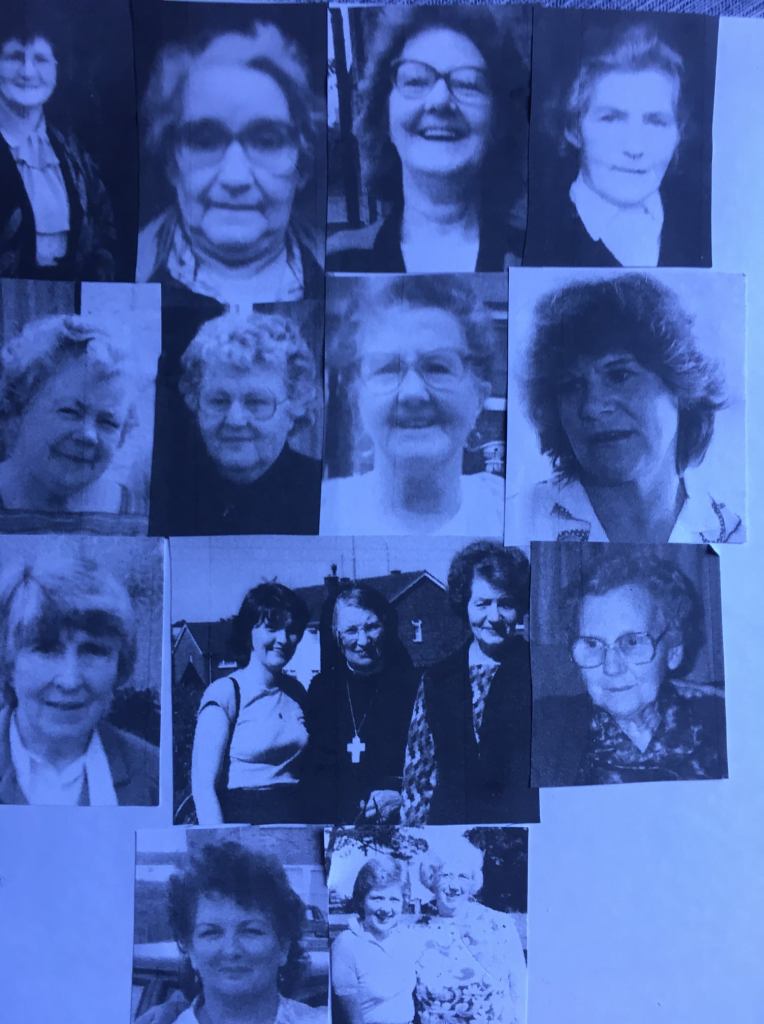
Closer still, there were those mothers too who filled my home and my life whist they endured the wait for freedom of their children, imprisoned until the miscarriages of British justice were laid bare. All of these mothers I remember. The first photograph in this post is of some of those mothers.
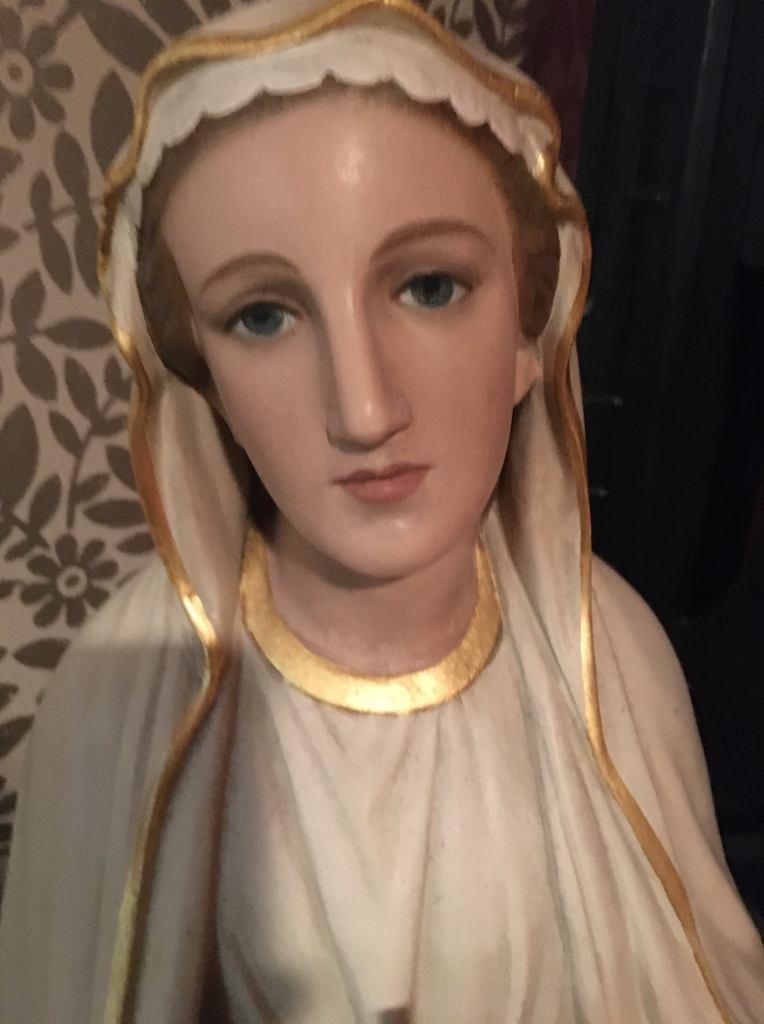
The other photograph in this post is of an almost life size statue of another mother, The Mother of God, Mary. Our Lady. She lived with me across those years and still does. This beautiful French statue has over time observed many moments of despair meeting with moments of hope. I know that because her feet are covered with lipstick! The lipstick kisses are from those decades I now recall, when Sr Sarah and I provided a home for the many relatives of Irish prisoners during their visits to loved ones in the British goals. During those years, if you were Irish in Britain at this time you were outcast and, much like with the Muslim community now, no one wanted to know. It was in this context that ‘Our Lady of the Lipstick’ as I now call her, came to symbolise so much.
The lipstick kisses remain as a symbol of those dark years and in particular indicate part of the story that is seldom recognised or told. As with the loved ones of most prisoners’ families, their story is characterised by despair and hope. I would see such etched on the faces of the mothers and wives when they would arrive as complete strangers on my doorstep. Many of them had suffered the humiliation of ‘guilt by association’ manifest in detention at the ports, strip -searches, harassment and racist abuse by the bucket load. Their fear was manifest across the few days they would stay with me. The despair of the present and of the future, what would become of their loved one? and indeed what would become of them? These were the questions behind every thought and word they uttered. But in all of that, the kisses to Our Lady still occurred and over the years her feet slowly became covered in the kisses of despair and hope.
As is so often in the stories of humanity, the raw experience of paradox reaches deep into our being and takes us, despite our protest, into territory far from any comfort we have ever known. Many others in our world are in such a place right now. Many without a cultural or spiritual resource of resilience to call upon and no feet on which to place kisses.
But regardless of lack of resource, regardless of lack of resilience, all experiences of paradox provide, if we dare to go there, a space of middle ground. The coming together of seemingly polar opposite experiences create, at their very meeting point, something different and it is often exactly that space where we need to go. It is in that middle space where resource is to be found.
The space created by the paradox of despair and hope we can call – acceptance.
Trauma, be that of a Irish prisoners relative in the 70’s and 80’s, the trauma induced by a virus in 2020 or a war against evil in 2025, provide to all those involved experiences of despair and hope.
Despair and hope are the defining features of specific trauma. I was privileged to gain a clinical specialism year at the Tavistock Clinic Trauma Unit many years ago. My mentor, Dr Caroline Garland, taught me that in response to traumatised clients our task was the re-installation of hope. When life experiences have eroded the supply of hope, like a mineral, it requires the right environment, care and attention to enable it to grow again. Her powerful analogy has stayed with me and is a constant reference point for me, not only in relation to my clinical work but in all areas of my life and in my connection with others.
Throughout life there is always much need for the re-installation of hope. We all need to work hard in the transformation of our own and others despair into hope. The process can and in many ways must start now and as indicated, it starts often by going, screaming and kicking maybe, to the place of acceptance, the acceptance of now.
It often would seem that we are afraid to hope. I know for sure that the kisses of hope planted on the feet of Our Lady were made in deep anguish with many tears. Such a place is where we come to acceptance, it’s never easy and what follows is unique for us all. But what I also know for certain is that the place of acceptance is always, always, always the place of peace. Even though we may not know that at the time.
When human connection occurs in safety it allows for a valuing of vulnerability rather than its banishing. Such experiences are rare in a world shaped by the ego and all its defences. But when a work is informed by the heart and a humility of spirit then such experiences flourish. These were my thoughts as I made my way home through Soho on this damp cold early November evening. In the heart of Soho, I just had such an experience.
Some weeks earlier, I had been invited to talk to a group of men about a challenging issue associated with vulnerability. I had just ten minutes to inspire and open up the discussion. Yes, my words were appreciated but what made the evening immensely inspirational for me was the safety and containment provided by the convenor. He was firm, direct, demanding of self -responsibility and respect of each other, things that often a ‘comfort zone’ driven emphasis or a ‘chronically nice’ environment tends to avoid. What followed was an experience of shared concern and shared great valuing one to another.
The experience reminded me of Mike Ford’s ‘The Flowers of Soho’ which appeared in the journal ‘Spirituality’ shortly after the Soho bombing in 1999. It powerfully resonated with me at the time. I have always regarded Soho as my spiritual home and a more sacred place, in the true meaning of the word, than temples or cathedrals. Mike got it too and generously conveyed it in his article when he wrote;
“Soho is a place where light can shine in the darkness, where creativity can blossom in a sea of ‘craziness’. The district may have its pornographic boutiques, it’s garish advertisement. Its smell of death, but it is also an oasis of life in a desert of loneliness, where alienated people sometimes succeed in finding new friends and forming community, where strangers can meet over a meal in one of the many restaurants and (referring to the bombing) where women and men now gather in solidarity in the aftermath of violent prejudice. As one card put by a wreath put it ‘you won’t kill love’.”
Such solidarity, concerning another manifestation of human vulnerability, was again being experienced within a gathering in the heart of Soho this evening. It was indeed a testament to whoever wrote those words that tragic time ago ‘you won’t kill love’.
Mike finished the same article with a quote from Henri J M. Nouwen. For me this quote expresses all that I constantly experience about this dreadful but beautiful place and particularly experienced this November evening;
“We are not alone; beyond the differences that separate us, we share one common humanity and thus, belong to each other. The mystery of life is that we discover this human togetherness not when we are powerful and strong, but when we are vulnerable and weak”.
Some time ago, I wrote about the impact of working with someone who had committed murder and who later, whilst in the professional care of colleagues and myself, took his own life. His death, resonated powerfully with me. The man, Stefano. had certainly required me to think about him whilst he was alive and, in his death, he required me to think again. In the years that have followed I’ve needed to continue thinking. Stefano does not stand alone., There are many I meet who have tragically murdered others and then go on in equal tragedy to murder themselves. But six years ago, at the time of Stefano’s tragic death, I wrote this …. They remain my thoughts …
A week has passed in my life where outwardly no one would have noticed anything different, internally it has been a profound and disturbing time. Events have first made me think of the one person who has inspired me more than any other and who informs my daily work and thinking, Sister Sarah Clarke, known and referred to since her death in 2000 as the ‘Joan of Arc’ for Irish Prisoners.
For several years I worked with Sr. Sarah by taking care of the relatives of Irish prisoners on remand or serving sentences in the UK. It was dangerous and stigmatising work. At that time to have connection with Irish prisoners, made you suspect, marked you out. Yes, during those years I was suspect, Special Branch visited me often, they bugged my flat and banned me from every prison in the UK. It is more than ironic that in later years I now have professional access to every prison in the UK and contribute daily to the welfare and justice of many who find themselves in prison, being released from prison or just avoiding prison.
How life can change!
Within myself nothing has changed, my belief in the dignity and sacredness of the human condition remains absolutely unchanged. After almost 30 years of working with murderers, rapists, so called terrorists and the like, I am even more convinced of our sameness and humanity. In our outward manifestations of lightness, we experience a myriad of difference, in our capacity for darkness and destruction we are frighteningly similar.
So why mention all this now? Well …this week I had to face the sudden death, in custody, of someone who suffered an incredible injustice, not necessarily in relation to the crime he had been convicted of, but of societies response to what he was and to who he was, long before any crime was committed. I have been around for a long time, long enough for deaths in custody to not shock me. It is not that fact that disturbs me, what does disturb me is the related issue of justice and how the very meaning of that word has become distorted beyond recognition.
The true meaning of justice is available for all of us to see. If we raise our sight above the Old Baily, we can see the scales of justice symbolised in the very architecture of the building, we are reminded that punishment and liberty are to be held in balance. When my client died in custody this last week, this balance had been abused and therefore a true justice has been denied. Who was guilty of this injustice? Who was guilty of this crime? It does not need a trial for me to pass sentence. The guilty in this case was, and is in my thinking, the corrupt, self-serving and inhumane media. I would also pass a guilty verdict to all those that invest belief in the media without question and pass judgement without resource to the true and full facts.
When taking relatives to various prisons with Sister Sarah back in the early 80’s we were often spat upon, we got to expect it. At that time, we were often doing our work in the service of innocent men and women, the relatives and those since cleared of their convictions (the Maguire seven, the Guildford Four, the Birmingham Six, Judith ward, etc) But innocent or guilty, there is a dignity about the human condition that is violated when compassion and care is denied no matter what the circumstances. If the process of compassion and care is denie, then process of change, rehabilitation and reparation is also denied, in my understanding this is nothing more than a repetition of the very crime committed and is best understood by the term ‘murder of the soul’.
What made this week so very painful was the willingness of the media and those that chose to believe it’s every word, to unthinkingly enter into a joint ‘murder of the soul’ of an individual that has only featured in their daily lives as a piece of print. The murder of this soul manifested in comments, judgments and shaming, all done without any recognition of the causes and influences factors or indeed the actual facts of the case. What damning and undignified state of humanity is indicated in this unthinking and unintelligent response. It was made even worse that much of this took place when the person had died and could not offer any defence.
There is a further injustice; the vile, distorted and self-serving media has full liberty to speak out unhindered. Where those of us who know the full facts, who know the causal and influencing factors and who have shared the realities of day-to-day life are denied a voice. We are silenced and not allowed to speak out because we are required to be ‘professional’.
Yes, I remained ‘professional’ but I also wept tears of sorrow, along with other dear colleagues, for the soul who died in custody.
You won’t be surprised to know that I am left angry. I remain deeply disturbed by individuals who continue to spit in the face of a true justice by believing and acting on every word of the sensationalist press. There is always a full story and it’s seldom the one in the headlines. Until this is recognised, I guess justice and all it is supposed to be will be spat upon. The problem is when we resort to spitting, in whatever way that may manifest, then we are not thinking and to have a mind is crucial for the full and humane execution of justice.
Four years on, I could add many other stories. The injustices continue. Souls continue to be murdered. Souls continue to murder. I still occasionally get spat at …. always a sign for me to carry on and more importantly not to stop thinking. There’s. truth in the paradox of Nothing changes, nothing lasts.
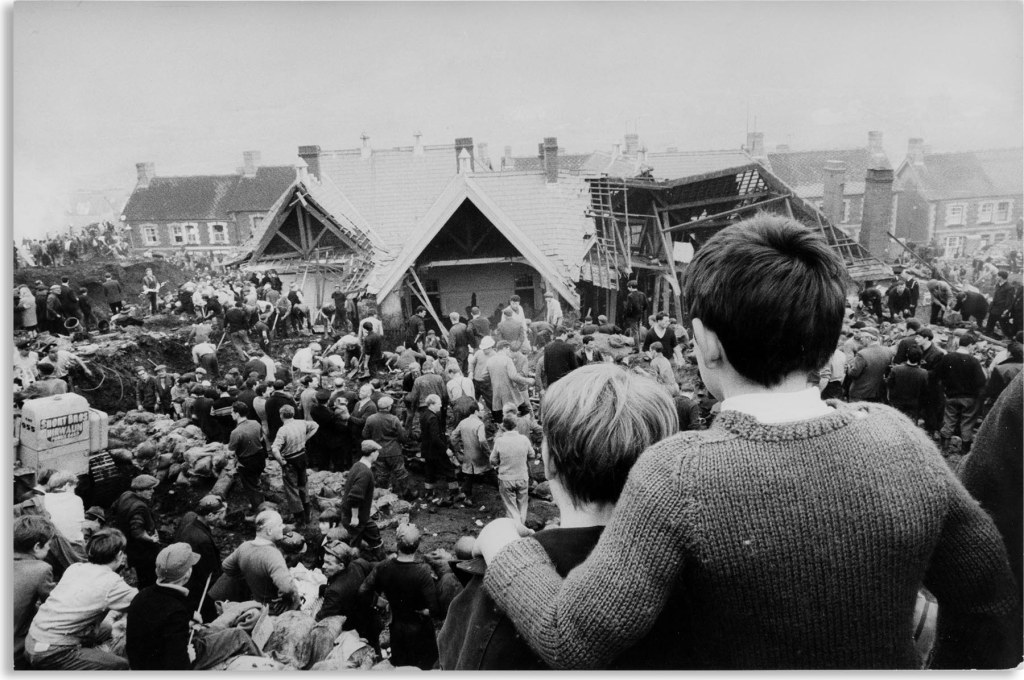
I didn’t realise at the time, but for me, the impact of the disaster that unfolded at Aberfan in the 1960’s set in motion of what has been a lifelong affinity with trauma. I guess it was the first mass trauma that I was old enough to understand. The first I could identify with as I was the same age as those children killed and my school looked just like the one crushed under the mountain of coal waste.
It was also the first time I could understand the injustices that soon came to light and that had caused it. The process of cover-up, denial and collusion all adding to the trauma. I did not know at that time I would spend decades as a clinician working with injustice and trauma – for me the two have been seldom separate.
I have now, in the years that followed Aberfan, worked with many individuals caught up in trauma of different kinds from the glaringly obvious as; Kings Cross, 7/7, Admiral Duncan and also the slow. slow, slow drip by drip trauma such as the war in Ireland, the AIDS crisis and in more recent times the increasing trauma’s linked to chemsex behaviour and crime. Although my involvement has been as a clinician, trauma involves me to the very core of my being, for that’s where we tend to experienced most.
Sadly, the term ‘trauma’ has become normalised, the word is banded around with little meaning. One of the consequences for this is that an authentic experience of trauma is then minimised, it not recognised for the havoc it causes and its debilitating effects on daily life. Trauma is treatable and can be recovered from but one of the most difficult barriers to this is that because of its very nature, everyone else knows the traumatic experience is over but the person having experienced does not know this. A radical new approach is needed in how we recognise trauma and how we respond to it.
Trauma is not only an individual experience it is also a collective experience. Couples, families, groups and whole communities can share in collective trauma, even when they have not been directly involved. The very nature of trauma is that it breaks through, it disrupts and invades all that we know to be protective and safe. In this process trauma has the capacity to disconnect, to separate and cause those suffering to feel and be regarded as other. From this disconnected place new vulnerabilities evolve as, often desperate attempts, are made to seek relief and reconnect.
Trauma cannot just be overcome and worked with in the consulting room. Healing and recovery from trauma needs to take place in the community, after all this is where it happens, this is where it is lived, and this is where it can be addressed.
I tend to know, without reading any reminder, the various anniversaries of traumatic events, even when I have not been directly involved. However, I often don’t know so readily the anniversaries of individual traumas that sit in the heart’s and lives of my friends. The fact that I don’t is a tragedy in itself. Until this can be achieved, much more is needed.
I will go so far as stating that in a connected community trauma is not possible. Genuine and authentic presence of connection provides a sense of security. It is a secure experience of attachment and a knowing that we are not alone which provides without doubt resilience. Resilience won’t stop traumatic events, but it certainly enables us to be survive in the face of them.
I am reminded of two people who were at the heart of the 7/7 bombings. Gill Hicks, who died several times and had both legs amputated and Aaron, a Police Officer who walked into a carriage and witnessed the vision of hell that he would never be able to remove form his memory.
Gill describes a childhood and experiences of community that were all we would associate with secure attachment, experiences of belonging and community.
Aaron’s childhood and life had sadly been the opposite.
In response to their experiences Gill never developed or experienced symptoms of any trauma, quite the opposite, she worked to achieve and created even more experiences of safe community. Aaron withdrew and community withdrew from him. In his isolation and loneliness, he developed a full-blown traumatic response. His pain and suffering hidden for a long time took much recovery.
The experience of these two inspiring people, the experience of those in Aberfan, anniversary after anniversary, are powerful reminders of the importance of connection and community. The role we all play in enabling connection and the role we all need to play in building resilience.
I remember where I was on 9/11 – In 2001, I had the opportunity to take a one year sabbatical away from my work with prisoners and my clinical role as a forensic psychotherapist. My superiors expected me to come up with a plan of rest and self-development. But after many years of my own therapy, personal exploration, directed retreats, self-directed retreats and more. The one thing I was certain about was that I did not want to give more time to self -analysis, self-development or anything like it.
Eventually, it was agreed that for a year I would take on the role as Director for Mission Effectiveness at a large Franciscan Hospital serving not the poor but the wealthy and sometimes famous. It was totally out of my comfort zone. Put me on any prison wing in the country, put me in any segregation unit, in any probation office and sit me with the most dangerous of killers, arsonists, rapists, bank robbers or gangsters and I am totally at home, and we all get on just fine. The highly polished, sterile corridors, the perfectly decorated rooms and the state of art operating theatres, filled with wealthy and fee-paying people was something else! Despite illness, the degree of comfort and niceness in this setting was overwhelming, to the extent that it was suffocating and to the extent that it was chronic. I experienced it like drowning in a bath of the sweetest sickliest candy floss you could possibly imagine. But I was there and more, I had asked to be.
Then something happened.
9/11 happened.
Slowly but surely the horror of the twin towers, all those thousands of miles away, seeped into and broke through all that chronic comfort and niceness within that beautiful hospital. Via endless and constant television and radio news reports a different reality started to emerge. The first notice I had of this happening was when the Director of Nursing asked to see me urgently. She was not so interested in my mission effectiveness role but wanted me immediately to act in my clinical pastoral role as psychotherapist and work with her staff. Several were having panic attacks, some were being physically sick, many were crying, some inconsolable. “Whatever you do’, she said, “please stop them being so distressed”.
I responded and for the remainder of that day and the following, I debriefed, I consoled and helped create something of a perspective. Calmness, and unfortunately to my thinking, chronic niceness was also eventually restored.
I have never sought to remove distress be that my own or others. I have always worked to be with others in their distress and have always believed that, although immensely difficult, to sit with one’s own distress is by far the wisest thing to do. I had long learned that trying to push distress away just causes more conflict, more unrest, more pain and especially so when distress is the right reaction to have. The instruction I had received to ‘stop the distress’ disturbed me. I had been required to make everything ‘nice’ again and at a time when for many nothing would never be ‘nice’ again and when the continued suffering of humanity would fill our screens, newspapers and lives again and again. As I walked around the hospital in the days that followed it was like being in a parallel universe; it was as if 9/11 had not, was not, happening – silence.
I knew exactly what had disturbed me about ‘stopping the distress’ and what continued to disturb me about the chronic niceness of that hospital. It was the disavowing, the banishment and the total denial of the need we have as humans to connect with each other and to connect especially at times of suffering. Those rightly distressed nurses had connected with love and compassion, and I had colluded with an effort to get them to return to a state of disconnect and a niceness that was just not real. Those nurses had responded exactly as St Francis would have done. The whole of his ministry most surely based on connection with the world around us and with each other. In one of his hospitals, it appeared that the very heart of his mission and purpose was not being allowed, it was being forbidden.
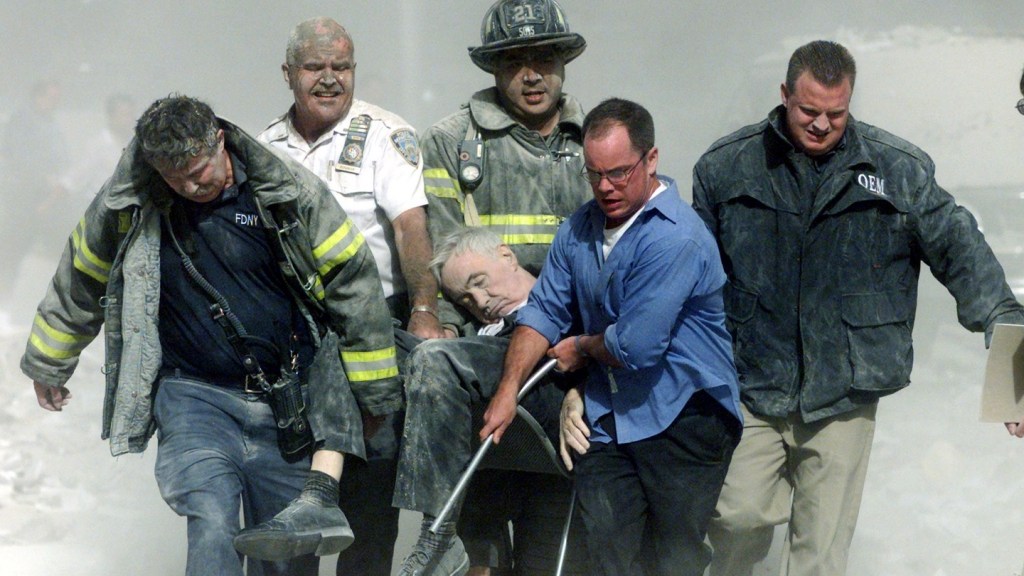
At the centre of the hospital was an enormous publicity board, it was used to communicate the tenants of mission effectiveness and Franciscan spirituality that had long ago led to the formation of the hospital. This space, rightly or wrongly, it occurred to me was mine. In my room I gathered together the largest sheets of card I could find, I got scissors, glue and every newspaper I could find. With great care I cut out each and every image of the suffering, wounded and dying people from in and around the World Trade Centre. I fitted them together into a montage that when assembled covered every inch of that massive Mission Effectiveness board. At its very centre I pasted the picture attached to this post. The picture is of Father Mychal Judge, a Franciscan priest who was chaplain to the fire fighters of NYC. On hearing the news that morning he had quickly removed his habit, put on his uniform and gone directly to be with his men and women. News footage shows him standing in one of the towers. The terror is visible on his face as his lips move silently in prayer and he prepares to minister to the injured, dead and dying. Sometime later another image is transmitted via the world’s media, it is Fr. Mychal who is carried out of the tower, his life given in the midst of unimaginable distress. By the side of this image I then pasted the prayer of St Francis.
Once in place, I stood back and looked at the finished montage, even I, its creator, was struck by its powerfulness. I was nervous, I did not know what reaction to expect. But I was equally aware that standing by the board and in view of the vision it created, I felt at home, I felt the sadness and horror it conveyed, and I felt it’s peace. I decided that’s where I would hang out. Word clearly spread and soon people from all over the hospital started to call by to look. In silence they looked, they wept, some gently touched the images, some thanked me and some went into the chapel and prayed. Some complained. The images, like Fr. Mychal, pulled no punches, it said it as it was. Humanity at its very worse and at its very best.
Humanity is seldom ‘nice’ we are, despite our intellect, primitive and awash with our needs, failings and vulnerabilities. We deny these things at great cost. When we don’t banish ours and others discomfort, when we allow ourselves to connect with our suffering and the pain of others. When we place ourselves in the way of risk, in the way of human tragedy and for the sole purpose of being together in all the shit that we ourselves so often create. Then it allows for something different to happen, for something different to be experienced.
By the time Fr. Mychal died alongside his people, he had seen terror and hell unfold on many occasions. As a gay priest in America at the height of the AIDS crisis he had held and kissed many who in the last days of their lives had been totally rejected by all around them. He had voiced and celebrated the joys of his and their sexuality and invited parents to be proud of their dying sons. No other voice in our world ever did this at that time.
The horror of 9/11 and the horror of the AIDS crisis are of course over but there will new horrors and some of us I guess will need to face such this very day. May we be able to meet whatever horror visits us as Mychal encouraged us to do so by how he was in the world – present, connected, vulnerable, flawed (as he often reminded us) but still willing to love. Father Mychal pray for us …
Twice, in as many days, the image of the joyous Christmas herald angels formed in my mind since early childhood has been challenged. First, when reading one of John O’Donohue’s poems this line jumped out of the page right at me “May the Angel of Justice disturb you to take the side of the poor and the wronged”. Then whilst listening to the wireless programme ‘A Yellow Light’, in which Nadin Ednan Laperouse recounts the traumatic death of his daughter Natasha from a severe allergic reaction after eating a sandwich. As his 14-year-old daughter lay dying in his arms he described vividly seeing several angel figures approaching and standing around her. Disturbed by their presence he tried to brush them away.
Both of these incidents reveal, that like many other of life mysteries, angels too are mysteries of paradox. As well as brining glad tidings their task would also appear to be to cause disturbance.
When disturbance manifest in our lives we tend not to like it. But what about being the one who causes disturbance, being the one who disturbs. What is it like to be that person? I’m no angel but I’ve been reminded on many occasions that I disturb people, some even pay for me to do just that. The hope of many is that a therapist will become their guardian, their salvation and their ‘bringer of good news’. Quite a shock then when I, as a therapist, view my task as absolutely not to do that. For what point would there be if such powerful ability was to reside in me? For the other, nothing would change.
It’s not unusual for someone at the start of a therapeutic process for them to ask what they should do? My response is always; be curious and be prepared to step out of any comfort zone. Some never return after this response, I guess it is they that recognise that I am offering an invitation, an expectation that they become disturbed.
Being a person who disturbs means being willing to be disturbed myself and to live my life often in the place of paradox. This often, uncomfortable place requires the willingness to recognise and then bring together the total and often extreme manifestations of the human condition within myself and within others. In practice, it means being able to hold in mind and value every version possible of the polar opposites that we all possess. It means naming them, calling them out, exposing them and placing them where they can be considered and where we can have a mind in relation to them. Love them even.
As a forensic psychotherapist and working in forensic settings this task is not as difficult as it may seem. There’s little illusion, or collusion actually, amongst those who have little reason to deny any more. I often encounter greater honesty and genuine connection on the inside of the prison gate than ever I do on ‘the out’. No, the challenge is found within other connection, relationships, friendships and of course within myself.
Being that person who causes disturbance is not formed or restricted to a job description or professional role, it is formed in the heart of life’s authentic experiences and cannot be turned on or off at choice.
Being that person who disturbs is also not limited to ‘what I do’, it’s also not about ‘what I am’ but more about who I am. This is in fact the essence of what some (and I) refer to as vocation. Vocation emerges as a way of being in the world in response to an internal ‘yes’ said to all of life and as it is represented. The occasion of me having that realisation and saying that ‘yes’ is another story and for another time. Enough to say perhaps that I’ve learned saying ‘yes’ is an ongoing requirement throughout life.
Vocation is, for want of a better explanation, all about saying ‘yes’ to paradox and accepting a way of being in the world without the need for denial, collusion or pretence. Owning this position, being willing to live it is what in psychology is referred to as living the authentic real self. If ever there was a purpose to any therapeutic process, it is this. If ever there was a time when this was required, it is most surely now.
Being that person who disturbs is, I have come to appreciate, one of the consequences of vocation, of saying ‘yes’ to life. Being the person who disturbs means saying “yes’ to the wholeness of life – light and dark. For one without the other, is no life at all. Being that person who disturbs means saying ‘yes’ to life not just once but over and again and again and again.
Saying ‘yes’ to life is the vocation we are all called to. Just how that gets played out for each of us will, for certain, hold many challenges. Whatever your place of authenticity is and whatever my place, we will each often find ourselves being an angel to others and always in need for one or more of those cherubs ourselves.